Competitive Psychology Beyond Traditional Sports: What Murder Mystery 2 Betting Reveals About Spectator Behavior
The Nielsen Sports Global Sports Report has repeatedly shown that millions of people engage with competitive events not simply for results, but for emotional experiences tied to uncertainty, identity, and shared attention. Spectators often invest themselves in outcomes because competition creates tension. Whether that tension appears inside a stadium or on a digital screen, the psychological mechanisms behind audience engagement can look surprisingly similar.
As digital environments have developed, researchers and observers have started paying closer attention to how communities respond to interactive forms of spectatorship. Platforms associated with murder mystery 2 betting have emerged as examples of this shift, illustrating how audiences can gather around unpredictable game outcomes and social participation patterns. Rather than viewing these systems purely through a gambling lens, they can also be examined as examples of changing spectator behavior and evolving competitive environments.
Traditional Sports and the Psychology of Audience Engagement
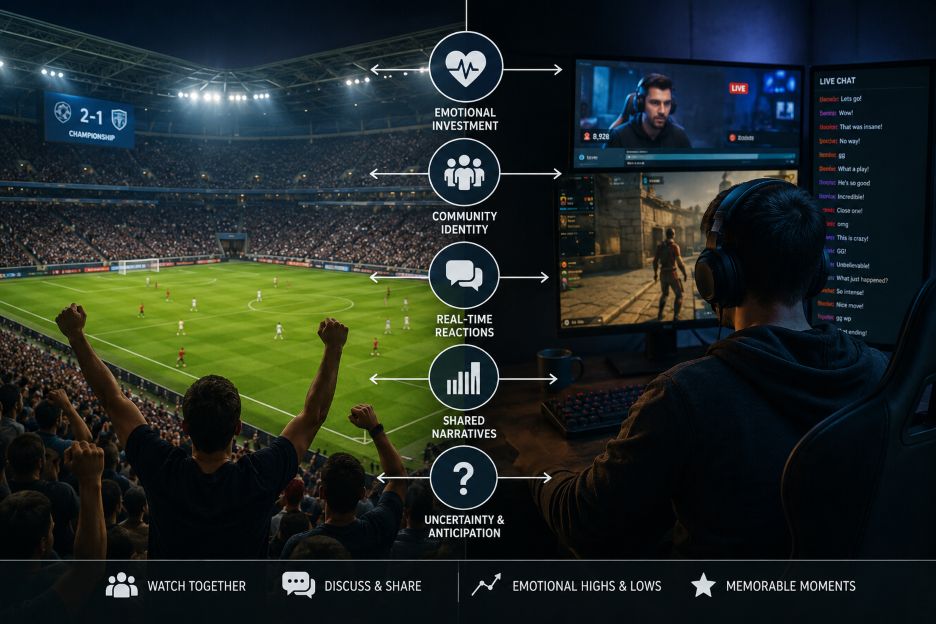
Competition has historically carried a strong emotional dimension. People follow teams, athletes, and events for reasons extending beyond scores and statistics. Long-term attachment, regional identity, and emotional investment often shape how viewers experience sports.
The American Psychological Association has noted that people naturally seek group belonging and shared experiences. Sporting communities frequently satisfy this need. Supporters celebrate together, react collectively to setbacks, and form social identities around teams or events.
This emotional pattern creates a cycle. Audiences become invested because outcomes remain uncertain. If every result became predictable, much of the anticipation would disappear. The possibility of surprise keeps attention active.
Traditional sports also create narratives over time. Rivalries develop. Unexpected performances create memorable moments. Individuals begin following personal stories alongside competitive results.
For decades, this model largely depended on physical arenas, television broadcasts, and organized leagues. However, digital environments introduced new spaces where similar reactions could emerge.
The Emergence of Competitive Behavior in Digital Environments
Interactive digital communities transformed how people experience competition. Instead of simply watching from a distance, users increasingly participate in environments where observation and interaction overlap.
Video games gradually moved from private entertainment activities into public experiences. Streaming platforms, community servers, and social discussion spaces changed spectatorship itself.
Research published by the Pew Research Center has shown that digital communities often function as social ecosystems where users build relationships, form identities, and engage in collective behavior. Competition became part of that ecosystem.
The interesting shift is that audiences in these environments frequently react emotionally even when traditional athletic performance is absent.
People still anticipate uncertain outcomes. They still discuss events afterward. They still form opinions and preferences around participants or scenarios.
Around online gaming ecosystems, observers may follow virtual item exchanges, match outcomes, or competitive interactions in ways that resemble audience behavior surrounding sporting events. Discussions surrounding MM2 wagering environments occasionally reflect these patterns because participants and observers become interested in anticipation itself rather than physical competition.
This raises an important question. Are audiences responding to competition, or are they responding to uncertainty and emotional tension?
Emotional Investment and Unpredictability
The comparison between traditional sports and digital competition reveals both similarities and differences.
The Similarities
- Both rely heavily on uncertain outcomes.
- Both generate emotional reactions.
- Both encourage social discussion.
- Both create memorable narratives.
- Both can establish communities around shared interests.
Research from Harvard Business Review has discussed how anticipation itself activates strong emotional responses. Human attention naturally increases when outcomes remain unresolved.
This principle appears across many environments.
Sports fans waiting for a final score experience uncertainty. Viewers watching competitive gaming moments experience uncertainty as well. The context changes, but the emotional structure often remains recognizable.
The Differences
Traditional sports usually involve longer narratives with established institutions, historical records, and athlete development pathways.
Digital competitive environments often move faster.
Moments appear and disappear quickly. Audience reactions may happen instantly through comments, streams, and online discussion spaces.
Shorter feedback cycles can create different forms of engagement. Emotional highs and lows may appear more rapidly because digital systems frequently operate in real time.
This speed does not necessarily increase meaning or emotional depth. However, it changes how spectators process events.
Traditional sports sometimes build attachment across decades. Digital spaces can generate intense reactions over shorter periods.
A Broader Interpretation of Competition and Spectatorship
The comparison between physical and digital competition suggests that spectatorship itself may be evolving rather than disappearing.
Older models placed audiences primarily in passive roles. People watched events and reacted afterward.
Modern environments increasingly blur these boundaries. Viewers comment instantly, share opinions continuously, and participate in surrounding communities while events unfold.
Competition becomes less about location and more about experience.
Psychologically, people appear drawn toward several recurring elements:
- Uncertainty and surprise
- Community participation
- Emotional tension
- Narrative development
- Social identity
These patterns existed long before digital systems emerged, and technology simply created new spaces where they could operate. Similar observations appear in discussions about how live sports betting influences fan excitement, where audience anticipation and real-time reactions are examined as important parts of the spectator experience. The underlying theme remains consistent: people often become deeply engaged when outcomes remain unresolved.
The World Health Organization has emphasized the importance of maintaining balanced media and gaming habits because repeated exposure to highly stimulating environments can affect behavioral patterns over time.
Reflecting on Competition Beyond the Stadium
Competition has always involved more than physical performance. It also involves anticipation, emotion, and human curiosity about uncertain outcomes.
Traditional sports and digital spaces may appear different on the surface, yet both reveal similar psychological foundations. Spectators frequently respond to suspense, shared experiences, and the emotional pull of unpredictability.
Communities surrounding virtual competition systems and MM2 gaming wager discussions show how these patterns continue to evolve in digital settings. The setting changes, but audience behavior often follows familiar paths.
Responsible gambling notice: Activities involving gambling carry financial and psychological risks. Participation should remain informed, measured, and approached carefully. Individuals experiencing difficulty managing gambling behavior should seek assistance from professional support organizations and responsible gambling resources.